
The French Emperor Napolean Bonaparte – he of the short stature and tall hat -supposedly once said an army marches on itʼs stomach. But thinking about it, an army actually marches on quality comfortable shoes. We as upright mammals, crave the kind of shoes that absorb the day to day pounding on our feet traversing East Van. But what happens when your favorite shoes blow a heel? Or the sole comes apart? The stitching frays or the tongue detaches? Do you toss them? No! Theyʼre your favorite shoes! Do you try Gorilla Gluing them? Yes! But when the glue no longer holds do you toss them then? No! Never! Thereʼs got to be a way to fix them. But where? Whoʼll do quality work and not charge you so much you start fantasizing about Boxing Day sales?
I found the answer. Sort of.
A year or so back, I begin to patronize a short commercial strip on the west side of Main at 48th. Itʼs one of those groupings of two storey buildings that canʼt possibly last in the condo clearcut we call home. I love these spots but always wonder, how much longer? This particular spot features two grocers, one of which Persian Foods has an inventory to match itʼs name, and a hair salon and a dentist. But it was only after multiple grocery runs, that a side glance lead me to the other business in this little block.
From the outside, I thought this space was an abandoned storefront. With itʼs faded sign and what looked like cramped cluttered shelves, I assumed the space had once had a business but now was sitting idle and empty. Then one day, the door was open, and the sign, which Iʼd never paid attention to, caught my eye. It was two words on the sign that drew me in; Skate Sharpening.
My immediate thought; ʻ Bullshit. Nobodyʼs sharpening skates in there. “
So in I went. It was small tight like it appeared on the outside, and crammed with old school Geppetto-esque machinery. An elderly Asian man worked hunched over one of the machines. I yelled to him, but nothing. Eventually he looked up.
Me; “ You sharpen skates here? “
Him; “ No more. I do hockey pants, hockey gloves, goalie pads. “
He pointed to a rack of things to be picked-up and amongst piles of shoes, was a pristine pair of goalie pads. That was the ice breaker. Turns out I was talking to Henry Ng an 88 year old cobbler who escaped from Maoʼs China in 1949 because in his words; “ Canʼt make money there. “ He went to Hong Kong then came to Vancouver in 1951. He got into shoe repair. Works everyday 11 to 7pm. Takes one holiday a year to go on a boat cruise. ʻTold me heʼd been in that location since the mid 1960ʼs. He even owned the building but wasnʼt interested in cashing in and selling. I was hooked. I gave him my hockey gloves to re-palm. I just one tiny concern. Henryʼs is a cash up front only business. The sole record of our transaction was a tattered stub of paper with a piece of green masking tape on it. He did have a business card with a phone number, but it was so old it didnʼt even have an area code. Plus at his advanced age, you know, Iʼm going to sound insensitive but, you wouldnʼt want to show up one day looking to pick up your stuff, and find the doors locked no Henry. It would be a tragedy, of course. But also it would be a huge hassle. I just want my gloves back I donʼt want to wait for probate.
Fortunately, Henry came through. A pro job on the gloves. Then I mentioned him to a lady friend and she went in with a favorite pair of multiply repaired broken heeled boots. After Henry did a nice job on the boots, she started rummaging through her closet for every favorite shoe sheʼd thought she might want fixed.
But then one day, a week ago, I saw a ragged hand written sign on his door. He was closing July 23rd. What? No! I went inside.
Me: “ What happened? “
Henry: “ I sell the business. “
He emphasized that he hadnʼt sold the building heʼd just sold the business. But nonetheless, after decades of repairing and extending the life of peoples footwear and equipment, slapping them together with what ever parts he could find, Henryʼs own parts were finally wearing out.
Henry; “ Canʼt hear. Feet no good. Back no good. Retire. “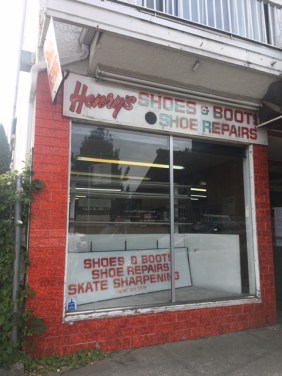
Henry did say though, it was still going to be a shoe repair shop. Somehow I suspect the clutter will disappear, and a new artisanal blacksmith will operate the premises. But then, is there such a thing as shoe repair gentrification?
By Contributing Writer Al Tee

 We introduce you to a new contributing writer Al Tee. Al loves a good story and has his eye on East Van’s history. His East Van roots go back to his grandmother’s childhood home and farm at 41st and Sophia. Today, he’s going to share a little East Van history in the Kensington-Cedar Cottage area.
  the garden is a shed that


 ILiveInEastVan.com